GEMM is crucial in AI inference, since it is the core of computations in many layers such as convolution and Transformer. This repo shows how I optimized GEMM by methods like SIMD registers, blocking, tiling, packing, parallel computing to achieve over 220x speed up (0.1747 -> 38.5153 GFLOPS) on Raspberry Pi 4 Model B (4GB RAM) using CPU only, reached the performance level of high-performance linear algebra libraries.
All matrices are row-major and initialized with values from text files, and thus the results should be constant. Once the computation is complete, the sum and elements will print for correctness checks.
Basic triple-nested loop to perform gemm. mm_naive.cpp achieved 0.1747 GFLOPS with elapsed time of 27224.92 ms.
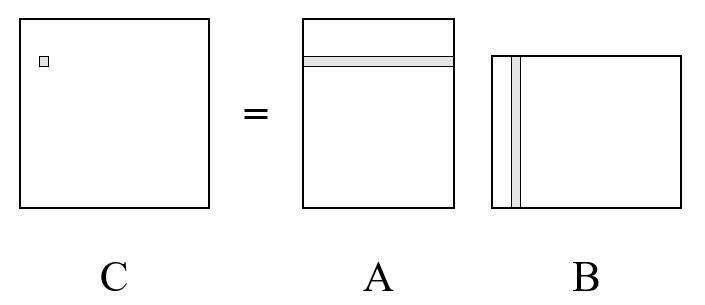
This step used neon registers (SIMD, equivalent to x64's AVX) to process multiple data with single instructions. A 4x4 kernel computes 16 elements of matrix C simultaneously, and elements in A and B only accessed from memory once per k loop instead of four times.
mm_kernel4x4.cpp improved performance to 1.5573 GFLOPS with elapsed time of 3054.31 ms.
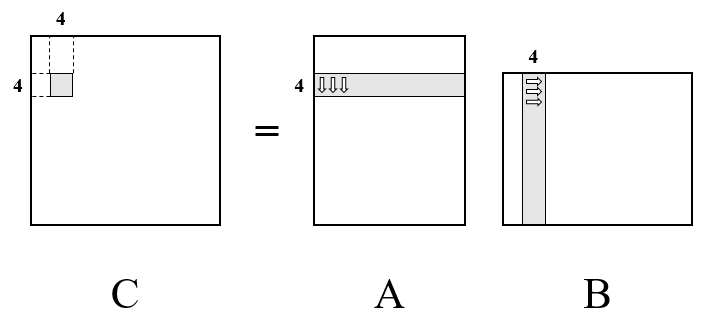
The next step is selecting a suitable kernel size. Cortex-A72 has 32 neon registers, and 20-30 registers is optimal for use. 12x8 was chosen to maximize register utilization, which requires 29 registers total (24 for C, 3 for A, and 2 for B).
mm_kernel12x8.cpp improved performance to 5.5944 GFLOPS with elapsed time of 850.19 ms.
The kernel efficiently utilizes registers, but cache usage remained suboptimal. For large matrices, FLOPS drop significantly due to frequent memory access. This can be addressed with blocking/tiling, which improves cache hit rates by enhancing data locality. Additionally, blocking supports parallel computation very well. Parallelization also improves cache utilization: each core has its own L1 cache and neon registers, while the 1 MB L2 is shared, so all four cores can work out of the same packed block. Furthermore, packing the blocks before computation also can enhance data locality.
After completing above optimizations, mm_block.cpp improved performance to 29.8623 GFLOPS with elapsed time of 159.28 ms.
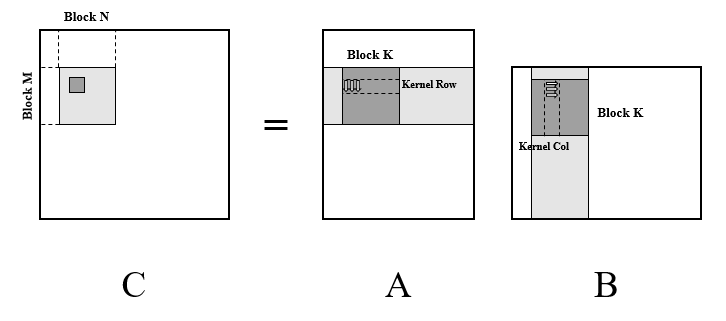
Blocking cuts the memory traffic, but the packed data gets rebuilt far more often than it needs to be: matrix A is repacked once per column block, and matrix B is packed by a single core before the parallel region even starts. Larger blocks would amortize both, except that they make things worse - the kernel reads packed matrix B with a stride, so the whole block has to stay in L1, and Cortex-A72 only has a 2-way 32 KB L1D.
Packing matrix B into 8-column panels instead of whole blocks removes that stride. Matrices A and B now both reach the kernel as plain sequential streams, which frees the block sizes and lets each matrix be packed just once, outside the loop nest. The gemm then fits in a single parallel region with no barriers, since every thread owns its own rows of matrix C, and the kernel prefetches a few k steps ahead to cover the panel boundaries.
Finally, mm_optimize.cpp improved performance to 38.5153 GFLOPS with elapsed time of 123.49 ms - a 220x speedup compared to the naive implementation! @_@
Most linear algebra libraries provide gemm supports, and I tested against some well-known libraries: blis, openblas, eigen, and gsl.
| Elapsed Time (x4) | GFLOPS (x4) | Release Tags | |
|---|---|---|---|
| optimize | 123.49 ms | 38.5153 | - |
| blis | 120.21 ms | 39.5670 | 0.9.0-156 |
| openblas | 151.21 ms | 31.4546 | 0.3.28 |
| eigen | 238.22 ms | 19.9660 | 3.4.0 |
| gsl | 7252.10 ms | 0.6559 | 2.8 |
My gemm outperforms openblas by 7 GFLOPS and eigen by over 18, and is about 1 GFLOPS slower than blis. Gsl does not provide an efficient implementation by default, resulting in very slow speed (but it can utilize other libs as backends for gemm computation if specified during build).