Install: run the user-local installer below — it creates a private venv and works on PEP 668 systems too:
curl -fsSL https://raw.githubusercontent.com/BGMLAI/gate.cat/master/install.sh -o /tmp/gatecat-install.sh
sh /tmp/gatecat-install.sh
Or use the manual venv path:
python3 -m venv .venv && .venv/bin/python -m pip install gate.cat.from gatecat import check_action # deny-list gate check_action("agent", "terraform destroy -auto-approve") # -> raises ActionVetoedThe distribution is
gate.cat(PyPI also accepts the normalized spellinggate-cat); the import module isgatecat. 0.2.x usedimport cacheback— seeMIGRATION.md. Honest line, up front: the gate is certain only about what it blocks. An action it does not match is unchecked, not safe.Scope — persistent environments. gate.cat guards places where a mistake is irreversible: a dev laptop with real data, a deploy pipeline, prod, paid infra. In a throwaway CI/sandbox container (a fresh git checkout that gets discarded) nothing is irreversible, so the gate disarms itself and logs a
disarmedno-op rather than crying wolf. It auto-detects CI markers;GATECAT_VETO_EPHEMERAL=0forces it armed anyway. Measured on 14.7k real Claude Code commands and a public HF corpus of 8.6k SWE-agent commands, it intervenes on ~0.6% of commands on both — the deny-list found something structural, not tuned to one user.
Stop your AI agent before it takes an irreversible action. The action-veto is
deterministic and model-agnostic — a deny-list + exec-check + human-in-the-loop that
inspects the tool call at the boundary, so it protects any agent the same way: a Claude Code
hook (frontier), a crewAI/LangGraph app, or a local 7-30B model on Ollama/vLLM. TruthPipeline
adds an honest verdict (confirmed / refuted / uncertain / unchecked) using deterministic checks
(exec/calc/lookup) plus a sample-spread uncertainty signal; veto.py consumes that verdict to
block, pause, or ask a human before a tool call executes. (That uncertainty signal — a
secondary feature — is where the 7-30B local-model strength lives; see "Why small/cheap models"
below. The veto itself needs no such assumption.)
One mechanism, not two products: the verification engine (TruthPipeline) and the action-gate
that consumes it (before_action / VetoGate) ship together — same package, same brand.
Semantic cache and Cache-Augmented Synthesis (below) are the supporting engine underneath both.





Real catches, monthly: gate.cat publishes Veto Catches — a real irreversible command an agent tried, and how the wall stopped it.
An AI agent decides to run a README's install one-liner. The gate stops it before
a single byte executes — a real terminal, pip install gate-cat, no montage:
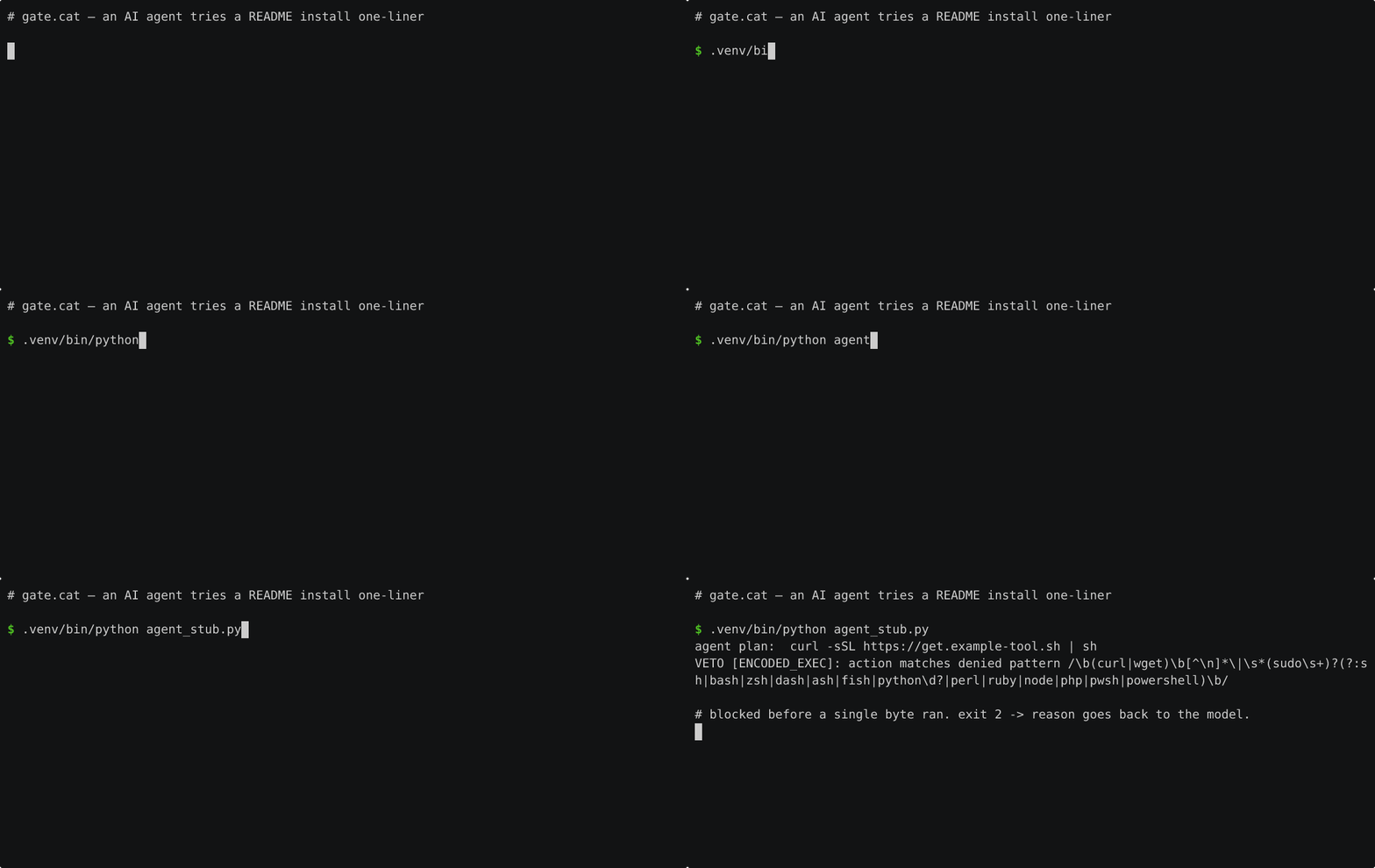
Blocks the curl … | sh pattern specifically; obfuscated/base64 install tricks still evade — see OBJECTIONS.md. Cast: docs/demos/demo_a.cast.
pip install gate.cat                  # core (inside a venv)
pip install "gate-cat[openai]"      # + OpenAI wrapper
pip install "gate-cat[anthropic]"   # + Anthropic wrapper
pip install "gate-cat[proxy]"       # + proxy server (FastAPI)
pip install "gate-cat[all]"         # everything
Quote the extras (
"gate-cat[openai]") — zsh treats bare[...]as a glob.
Enforcement in the harness, outside the model's control flow: the tool call
cannot execute until the gate returns. pip install gate-cat puts the
gatecat-hook console script on your PATH; register it as a Claude Code
PreToolUse hook by adding this to .claude/settings.json (nothing to edit —
it's called by name, no absolute paths):
{
  "hooks": {
    "PreToolUse": [
      {
        "matcher": "Bash|Write|Edit",
        "hooks": [{ "type": "command", "command": "gatecat-hook" }]
      }
    ]
  }
}
Now ask your agent to run rm -rf ~/project: the call is blocked (exit 2) and
the model sees VETO [DELETE_ANALYZER]: deletes '/home/you/project' under protected root '/home' - requires a human. A delete under a throwaway path like
/tmp/x is deliberately allowed — the gate stops deletes that touch a
persistent location, and doesn't nag on scratch dirs. Run gate.cat any time to
see what it's watched and stopped. Fail-closed: a missing or erroring engine
blocks rather than allowing. In a throwaway CI/sandbox it disarms itself and
logs a no-op (GATECAT_VETO_EPHEMERAL=0 forces it armed).
Framework adapters (crewAI / LangGraph / AutoGen) exist too, but they are
in-process convention — a prompt injection can route around them. Only the hook
is enforcement the agent cannot skip. See
examples/veto_integrations/ for adapter usage.
Not on Claude Code? The hook only fires there, and the proxy only sees what an
OpenAI-API model layer emits. But almost every agent ultimately runs a command
through a shell — sh -c "<command>". gatecat-shell sits at that exec point:
point the agent's shell at it and every command is vetted by the same
deterministic engine the hook uses, before the real shell runs it.
# gate one command, then run it — block => exit 2, the real shell never sees it
gatecat-shell -c "rm -rf ~/project"     # VETO [DELETE_ANALYZER] ... exit 2
gatecat-shell -c "git status"           # allowed -> execs /bin/sh -c "git status"

# gate only, no exec (the primitive for git hooks, CI wrappers, other agents)
gatecat-shell --check "terraform destroy -auto-approve"   # exit 2
echo "DROP TABLE users" | gatecat-shell --check           # exit 2

# for any agent that drives a bash session you can seed: a DEBUG-trap gate
eval "$(gatecat-shell --install-bash)"
Point an agent's execution at it wherever the tool lets you set the shell
command (many honor $SHELL or a config exec setting). The real shell is
/bin/sh; set GATECAT_SHELL_REAL=/bin/bash to change it. The gated command is
passed through byte-for-byte — the gate saw the exact string it runs, so there
is no re-parse gap.
Trust class, labeled honestly. Set as the agent's shell binary (-c
mode), this is enforcement outside the model's control — the same class as the
hook. The --install-bash DEBUG trap is weaker: a command inside the session
can trap - DEBUG to disarm it, so prefer setting the shell binary where you
can. Either way it is a string gate, not a sandbox — it reads the command,
it does not contain the process; run the agent in an OS sandbox and keep the
gate in front. Fail-closed: an engine fault, an unparseable -c, or an
evaluation error exits 2 rather than running the command.
The deny-list stops one dangerous command; it says nothing about a loop of
safe commands that never makes progress — the agent re-running a failing
build, or re-proposing the same broken fix. StateStagnationDetector watches
the agent's STATE across steps and stops it when the state stops moving:
from gatecat.state_stagnation import StateStagnationDetector

det = StateStagnationDetector(max_repeat_action=2, max_no_change=2)
for step in agent_loop():
    reason = det.update(action=step.tool_call, state_repr=step.diff,
                        error=step.error, cost=step.cost, progress=step.tests_passing)
    if reason:
        pause_and_report(reason); break     # the loop isn't moving — turn back / escalate
update() returns the reason of the first tripped signal (repeat_action,
no_state_change, repeat_error, cost_without_progress) or None. It is
deterministic — the point is that a coding error is often confident-wrong:
the model re-proposes the same bad fix with zero scatter, so a probabilistic
disagreement gate is blind to it, while a state comparison catches the loop
regardless of confidence. Advisory (a runaway agent is wasted budget, not an
irreversible action). Distinct from the koryto StagnationMonitor, which watches
the retrieval channel rather than the agent.
One entry point that composes the SDK's verification blocks into a truth +
compliance pipeline for ANY model (a 3B SLM on a phone and a frontier LLM use
the same sample_fn callback).
from gatecat import TruthPipeline, ActionPolicy, ActionVetoed

pipe = TruthPipeline(
    sample_fn=my_llm,                              # callback(prompt) -> str
    fact_base={"capital of france": "Paris"},      # lookup channel (optional)
    policy=ActionPolicy(deny=[r"terraform.*prod"], max_amount=100.0),
)

r = pipe.evaluate("Evaluate: 6 / 2 * 3", answer="1")
r.verdict   # "refuted" — caught confident-wrong, deterministically, $0
r.truth     # "9" — the correct value, so the caller can self-correct

@pipe.guard()                                      # compliance on ACTIONS
def deploy(target): ...
deploy(target="terraform apply prod")              # raises ActionVetoed BEFORE executing

pipe.compliance_report()                           # audit trail: verdicts + vetoes
A policy in action: dev runs, destroy prod is denied, apply staging escalates
to a human — one deterministic gate, three outcomes:
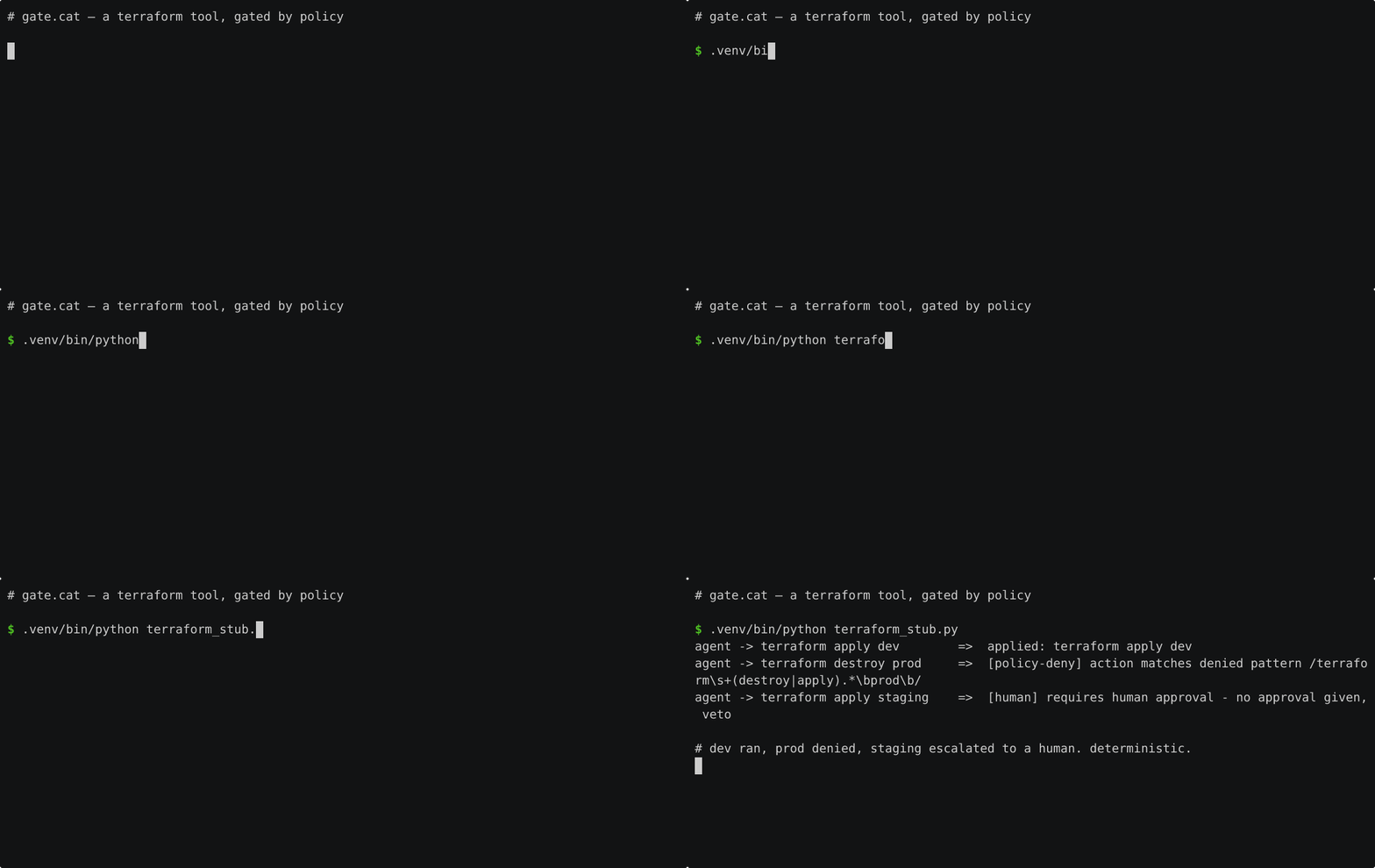
Source: examples/veto_terraform.py. Cast: docs/demos/demo_b.cast.
Honest verdicts — the pipeline never claims more than it measured:
| Verdict | Meaning | reliable |
trusted |
|---|---|---|---|
confirmed |
answer matches a verified atom (exec/calc/lookup) | ✅ | ✅ |
refuted |
answer contradicts a verified atom | ❌ | ❌ |
uncertain |
soft disagreement without arbiter, or high sample spread | ❌ | ❌ |
unchecked |
outside verification reach — not "true", just "couldn't check" | ❌ | ✅ |
For critical systems filter on report.reliable (confirmed only), not trusted.
Gate catches HESITATION, not LYING. When the model is confidently wrong (same N probes, same wrong answer — zero spread), that's invisible to disagreement. The gate is an uncertainty signal → pause/escalate, NOT a correctness guarantee.
Verdict precedence (conflicts are resolved by construction):
exec/calc(hard, physically independent of the model) always win — the gate isn't even asked.lookupdisagreement goes to the optionalarbiter_fn; without one →uncertain(setlookup_hard_block=Trueonly if your fact base is fresh at query time).gate(sample-spread) runs only when no verified atom exists.vetois an orthogonal axis: it judges actions, is fail-closed, andguard()without a policy raises instead of silently allowing everything.
Methods: evaluate(q, answer) verifies an existing answer · ask(q) generates
with sample_fn then verifies · guard() decorates a tool function with pre-execution
veto · check_action(repr) evaluates an action without running it.
arbiter_fn contract: (question, answer, KorytoVerdict) -> Optional[bool] —
True = the fact base is right (refute stands), False = the model was right
(stale base, answer confirmed), None/exception = no ruling → uncertain.
Every stage that spoke is recorded in report.stages for debugging.
Why small/cheap models (this is about the uncertainty signal, not the veto — the veto is model-agnostic): agents increasingly run on cheap/local models (7-30B via Ollama/vLLM) for cost and data-residency. That's where the gate's uncertainty signal is strongest (AUC 0.77–0.90, measured N=4800) and where frontier-first guardrail vendors don't aim — on frontier models the signal weakens (AUC 0.68–0.71). The action-veto's deny-list + exec-check does not depend on model size at all; it protects a Claude Code (frontier) agent exactly as it protects a local one.
Naming note: koryto (Polish: riverbed) is the project's canonical term for the
deterministic verification layer — the probabilistic "river" (model output) is held
by a deterministic "riverbed" (exec/calc/lookup). It is a deliberate brand term, not
an accident of translation.
Sixty seconds of your time, in exchange for:
- a deterministic gate your agent cannot run
terraform destroy,rm -rf,DROP TABLEorgh repo deletethrough — 71 default policies for the irreversible-action class, fail-closed, ~0.6% intervention rate measured on real traffic (it won't nag you); - a ready-to-paste Claude Code PreToolUse hook — the strongest mode: enforcement in the harness, outside the model's control flow;
- adapters for crewAI / LangGraph / AutoGen (honestly labeled: in-process convention, weaker than the hook);
- one-line uninstall if it's not for you. Worst case, you lost a minute.
What we ask back — this project runs on one currency:
- 🐛 a veto story — tell us what got caught, or what slipped through. Misses are worth more than praise: reported gaps get fixed and credited in the CHANGELOG, and the bypass suite grows from exactly these reports. …and if the gate ever blocks something dumb before it happened, a ⭐ helps other people find this.
The local gate is free forever — including local reports. The paid layer, gate.cat Cloud, is the off-machine copy of your veto history — the one an agent with shell access can't delete or rewrite (a local log is inside its blast radius). Launch prices: Solo €19/mo · Team €149/mo flat (up to 10 machines) · Business €399/mo. Stripe checkout is live with automatic activation and subscription lifecycle handling. The local gate remains free forever. Start Solo (€19/mo) · Team — €149/mo flat, up to 10 machines · Business (€399/mo) — or buy a one-time €29 policy pack: Fintech · PaaS · HTTP-API Breadth.
Running agents across a team? One rogue agent's blast radius is the whole team's. The team plan adds a shared off-machine veto history no single agent can delete, fleet alerts, and signed policy sync — walked through on the dedicated page: the team plan → gate.cat/teams.html.
Full boundaries and tier details: PRICING.md.
Teach AI coding, or write a dev newsletter? There's a partner program — 30% recurring, for the lifetime of the subscription, on every paid plan someone starts from your link. The core stays free, so you recommend real value, not a paywall: partner program → gate.cat/partners.html.
Every public number traces to a row in FACTS.md (claim → source →
allowed wording), and the corpus harnesses behind the headline measurements are
in scripts/ — reproduce them, and if your numbers
disagree with ours, that's a bug report we want. The 14.7k-command half of the
~0.6% claim is our own private log (labeled as such in FACTS.md); the public
corpus half you can re-run yourself.
Recall — the claim we care about most (does anything dangerous get through?) is measured on two axes in RECALL.md. The deterministic one needs no datasets and runs in seconds:
git clone https://github.com/BGMLAI/gate.cat && cd gate.cat
pip install -e .                       # the veto engine (zero-dependency core)
python scripts/recall_danger_axis.py   # 43/43 known danger classes through the FULL gate, 0 false-blocks
(The harness lives in scripts/ — not shipped inside the pip wheel — so verify
it from a clone, where you can also read the danger catalog it checks against.)
The verification/veto layer above runs on top of a semantic cache. Used standalone, the cache also works as a drop-in wrapper for OpenAI/Anthropic SDKs with a three-tier response: verbatim cache, synthesis, upstream — cache semantically similar queries and return instant responses (<10ms), or synthesize from cached knowledge (~300ms, ~$0.002) instead of a full upstream call.
from gatecat import CachedOpenAI

client = CachedOpenAI(api_key="sk-...")

# First call: ~500ms (API + cache populate)
response = client.chat.completions.create(
    model="gpt-4o",
    messages=[{"role": "user", "content": "What is the capital of France?"}],
)

# Second call with similar query: ~5ms (cache hit)
response2 = client.chat.completions.create(
    model="gpt-4o",
    messages=[{"role": "user", "content": "capital of France?"}],
)
print(response2.gatecat_hit) # Truefrom gatecat import CachedAnthropic
client = CachedAnthropic(api_key="sk-ant-...")
message = client.messages.create(
model="claude-sonnet-4-20250514",
max_tokens=1024,
messages=[{"role": "user", "content": "What is Python?"}],
)
print(message.gatecat_hit) # True on cache hitStreaming works transparently. Cache misses buffer and store the response; cache hits replay as a synthetic stream.
stream = client.chat.completions.create(
    model="gpt-4o",
    messages=[{"role": "user", "content": "Explain quantum computing"}],
    stream=True,
)
for chunk in stream:
print(chunk.choices[0].delta.content or "", end="")When a query is similar to cached entries but not an exact match, CAS synthesizes a fresh response from cached knowledge using a cheap LLM — instead of calling the expensive upstream API.
from gatecat import CachedOpenAI

client = CachedOpenAI(
    synthesis_mode="auto",  # enable three-tier response
    # Uses Gemini Flash Lite via OpenRouter by default (~$0.002/synthesis)
    # Or point to local llama-cpp: synthesis_model="local/phi-4-mini"
)

response = client.chat.completions.create(
    model="gpt-4o",
    messages=[{"role": "user", "content": "Explain photosynthesis"}],
)

if response.gatecat_hit:
    print("Verbatim cache hit (<10ms, $0.00)")
elif response.gatecat_synthesized:
    print("Synthesized from cache (~300ms, ~$0.002)")
else:
    print("Upstream API call (~500ms, ~$0.03)")
Three-tier response:
Query --> Embed --> HNSW search
|
sim >= 0.92 | VERBATIM HIT --> Return cached response <10ms $0.00
sim >= 0.80 | SYNTHESIS --> Top-K cached Q&A + LLM ~300ms ~$0.002
sim < 0.80 | UPSTREAM MISS --> Call API, cache response ~500ms ~$0.03
Validated with 100-question benchmark across 5 domains: 0.892 mean quality ratio vs direct API responses.
Ollama, NIM, OpenRouter, vLLM and LM Studio all speak the OpenAI API, so one
proxy in front of them protects them all — your agent changes one base_url,
writes no code. When the model asks to run a tool, the proxy checks the proposed
call against the 21 deny policies and blocks the dangerous ones before the
agent executes them (rm -rf, terraform destroy, DROP TABLE, disk wipes,
repo deletion, ...).
pip install "gate-cat[proxy]"

# point the proxy at your provider (local Ollama shown; NIM/OpenRouter/vLLM the same)
export OPENAI_BASE_URL="http://localhost:11434/v1"    # your real provider
export GATECAT_ALLOW_INSECURE_UPSTREAM=1              # only for a local http provider
gatecat-proxy                                         # listens on :8080
Then your agent points at the proxy instead of the provider — that's the whole change:
client = OpenAI(base_url="http://localhost:8080/v1") # was 11434; now guardedA dangerous tool call comes back as a refusal, not an execution. Modes:
GATECAT_PROXY_TOOL_VETO=block (default) / flag (annotate only) / off.
Caveat: this gates tool calls the model makes through the API; an agent that
shells out directly still needs the harness hook (gatecat-hook).
Run gate.cat as a standalone proxy server. No SDK integration needed — just change base_url:
# Docker (recommended)
docker run -e OPENAI_API_KEY=sk-... -p 8080:8080 gatecat/proxy

# Or pip
pip install "gate-cat[proxy]"
gatecat-proxy  # starts on :8080
Then point your existing code at the proxy:
from openai import OpenAI

client = OpenAI(base_url="http://localhost:8080/v1")  # that's it
response = client.chat.completions.create(
    model="gpt-4o",
    messages=[{"role": "user", "content": "What is Python?"}],
)
# Cache headers: X-Gatecat-Hit, X-Gatecat-Synthesized
Works with any OpenAI-compatible client (curl, LangChain, LiteLLM, etc). Configure via environment variables:
| Variable | Default | Description |
|---|---|---|
OPENAI_API_KEY |
— | API key for upstream provider |
GATECAT_SIMILARITY_THRESHOLD |
0.92 |
Cache hit threshold |
GATECAT_SYNTHESIS_MODE |
off |
off / auto / always |
GATECAT_TTL |
86400 |
Cache TTL in seconds |
GATECAT_PORT |
8080 |
Server port |
from gatecat import AsyncCachedOpenAI, AsyncCachedAnthropic

async_client = AsyncCachedOpenAI()
response = await async_client.chat.completions.create(
    model="gpt-4o",
    messages=[{"role": "user", "content": "Hello"}],
)Use SemanticCache directly for any embedding-based caching:
from gatecat import SemanticCache

cache = SemanticCache(
    similarity_threshold=0.92,
    cache_ttl=86400,  # 24 hours
)

cache.populate("What is Python?", "Python is a programming language...")
result = cache.lookup("Tell me about Python") # cache hitBlock known-bad query patterns before they hit the API:
# Block a query pattern
client.cache.negative.add(
    "What is the airspeed of an unladen swallow?",
    reason="hallucination",
)

# Similar queries are now blocked
client.cache.negative.check("airspeed of swallows")  # returns match info

# Manage the blocklist
client.cache.negative.list(limit=50)
client.cache.negative.remove(entry_id=42)
client.cache.negative.report_false_positive(entry_id=42)client = CachedOpenAI(
# Cache settings
cache_dir="~/.gatecat", # where to store cache data
similarity_threshold=0.92, # cosine similarity for cache hit (0-1)
negative_threshold=0.85, # threshold for negative cache
cache_ttl=86400, # TTL in seconds (24h default)
cache_max_entries=100_000, # max entries before LRU eviction
cache_enabled=True, # set False to disable
on_negative_hit="raise", # "raise" | "skip" | callable
# Synthesis settings (CAS)
synthesis_mode="off", # "off" | "auto" | "always"
synthesis_model="google/gemini-2.0-flash-lite-001", # any OpenAI-compatible model
synthesis_model_base_url=None, # auto-detected from OPENROUTER_API_KEY
synthesis_model_api_key=None, # auto-detected from env
synthesis_threshold=0.80, # min similarity for synthesis candidates
synthesis_top_k=5, # number of cached Q&A pairs for synthesis
# OpenAI settings (passthrough)
api_key="sk-...",
)Query --> Embed (MiniLM-L6, 384-dim) --> Search HNSW index
|-- VERBATIM HIT (sim >= 0.92) --> Return cached response (<10ms)
|-- SYNTHESIS (sim >= 0.80) --> Top-K cached Q&A + cheap LLM (~300ms)
'-- MISS (sim < 0.80) --> Call upstream API, cache response (~500ms)
- Embedder: ONNX MiniLM-L6-v2 (90MB, runs locally, no API calls)
- Index: hnswlib HNSW for fast approximate nearest neighbor search
- Store: SQLite with WAL mode for concurrent access
- Fallback: numpy brute-force if hnswlib is unavailable
gatecat-cli stats          # Show cache statistics
gatecat-cli entries        # List cached entries
gatecat-cli evict          # Remove expired entries
gatecat-cli clear          # Clear all entries
gatecat-cli lookup "query" # Test a cache lookupRegister your own embedder for any modality:
from gatecat.embedders import BaseEmbedder, register_embedder
import numpy as np

class MyEmbedder(BaseEmbedder):
    dim = 256
    modality = "custom"

    def encode(self, input_data) -> np.ndarray:
        # Your embedding logic here
        ...

register_embedder("my-embedder", MyEmbedder)
cache = SemanticCache(embedder="my-embedder")
Built-in embedders: minilm (text), clip (image, coming soon), clap (voice, coming soon).
| Feature | gate.cat | GPTCache | LiteLLM | Redis LangCache |
|---|---|---|---|---|
| Semantic similarity | Yes | Yes | Exact only | Yes |
| Cache-Augmented Synthesis | Yes | No | No | No |
| OpenAI drop-in | Yes | Partial | Yes | No |
| Anthropic drop-in | Yes | No | Yes | No |
| Streaming support | Yes | No | No | No |
| Negative cache | Yes | No | No | No |
| Multimodal (planned) | Yes | No | No | No |
| Async | Yes | No | Yes | No |
| Zero config | Yes | No | No | No |
| Proxy mode (Docker) | Yes | No | Yes | No |
| Local (no server) | Yes | Yes | No | No |
| License | Apache 2.0 | MIT | MIT | Redis |
Apache 2.0 — see LICENSE.
Built by BGML.ai / Fundacja BLOOM. Policy Packs → gate.cat/#packs