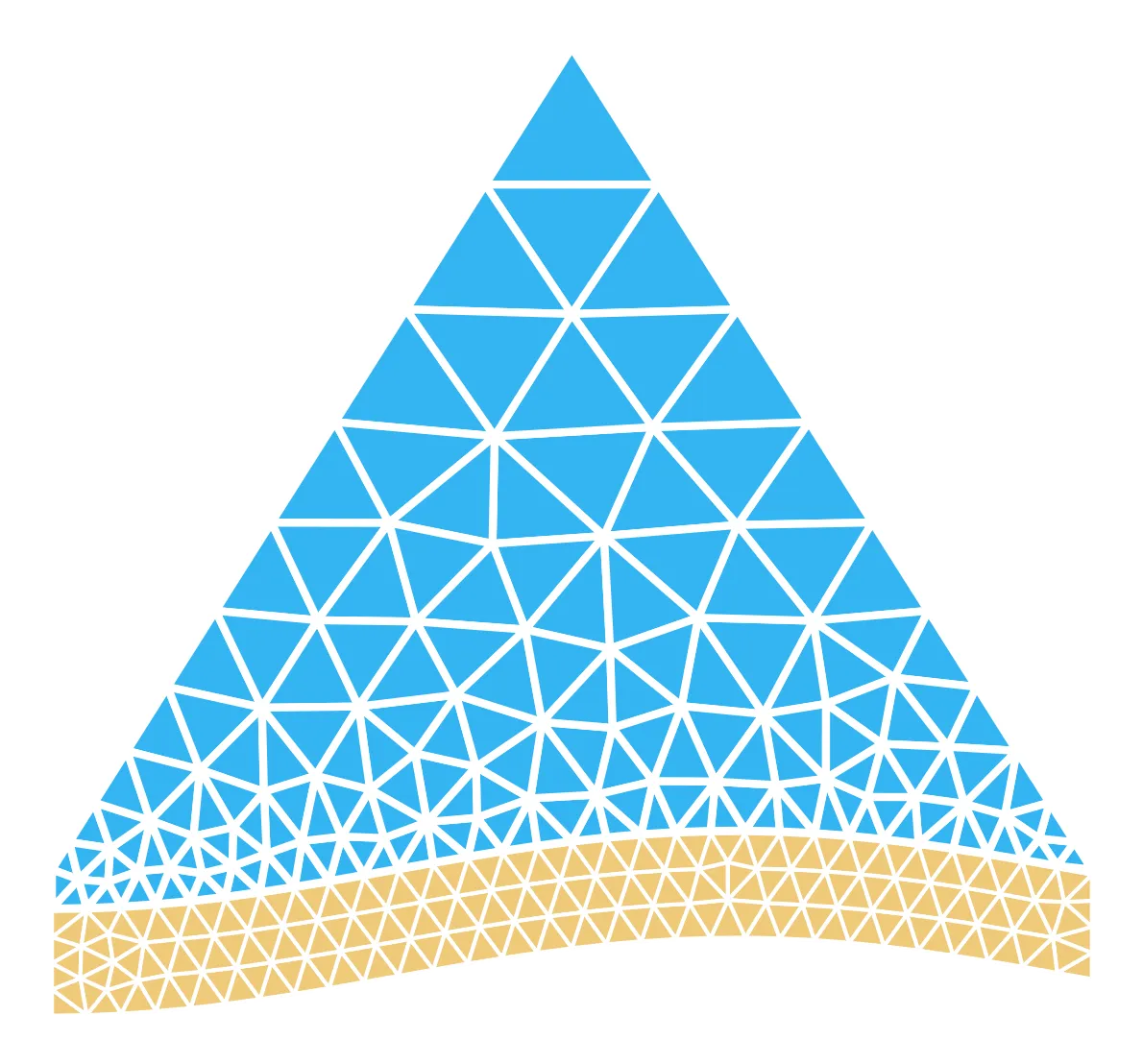
BlueMesh2D is the successor of PyMesh2D. The repository has been recreated under its new name as part of the BlueMath ecosystem. While the repository history has changed, the codebase and its development continue from the original project.
BlueMesh2D is a Python-based unstructured mesh-generator for two-dimensional polygonal geometries, providing a range of relatively simple, yet effective two-dimensional meshing algorithms. BlueMesh2D includes variations on the "classical" Delaunay refinement technique, a new "Frontal"-Delaunay refinement scheme, a non-linear mesh optimisation method, and auxiliary mesh and geometry pre- and post-processing facilities.
This code is a translation of MESH2D, a MATLAB / OCTAVE-based tool developed by Darren Engwirda.
Algorithms implemented in BlueMesh2D are "probably-good" - ensuring convergence, geometrical and topological correctness, and providing guarantees on algorithm termination and worst-case element quality bounds. Support for user-defined "mesh-spacing" functions and "multi-part" geometry definitions is also provided, allowing BlueMesh2D to handle a wide range of complex domain types and user-defined constraints. BlueMesh2D typically generates very high-quality output, appropriate for a variety of finite-volume/element type applications.
BlueMesh2D is a simplified version of my JIGSAW mesh-generation algorithm (a C++ code). BlueMesh2D aims to provide a straightforward Python implementation of these Delaunay-based triangulation and mesh optimisation techniques.
BlueMesh2D is a pure Python package, consisting of a core library + associated utilities:
BlueMesh2D::
├── bluemesh2d              -- core BlueMesh2D library functions. See refine, smooth, tridemo etc.
├── bluemesh2d/aabb_tree    -- support for fast spatial indexing, via tree-based data-structures.
├── bluemesh2d/geom_util    -- geometry processing, repair, etc.
├── bluemesh2d/geomesh_util -- mesh management, export, interpolation, etc.
├── bluemesh2d/hfun_util    -- mesh-spacing definitions, limiters, etc.
├── bluemesh2d/hjac_util    -- solver for Hamilton-Jacobi eqn's.
├── bluemesh2d/mesh_ball    -- circumscribing balls, orthogonal balls etc.
├── bluemesh2d/mesh_cost    -- mesh cost/quality functions, etc.
├── bluemesh2d/mesh_file    -- mesh i/o via ASCII serialisation.
├── bluemesh2d/mesh_util    -- meshing/triangulation utility functions.
├── bluemesh2d/ortho_merge  -- mesh orthogonalisation & merging (Delft3D-FM).
├── bluemesh2d/poly_data    -- polygon definitions for demo problems, etc.
└── bluemesh2d/poly_test    -- fast inclusion test for polygons.
You can install bluemesh2d directly from PyPI:
pip install bluemesh2dIf you want to install it in developer mode (for local development and contribution):
pip install -e .python -m bluemesh2d.tridemo 0; % a very simple example to get everything started.
python -m bluemesh2d.tridemo 1; % investigate the impact of the "radius-edge" threshold.
python -m bluemesh2d.tridemo 2; % Frontal-Delaunay vs. Delaunay-refinement refinement.
python -m bluemesh2d.tridemo 3; % explore impact of user-defined mesh-size constraints.
python -m bluemesh2d.tridemo 4; % explore impact of "hill-climbing" mesh optimisations.
python -m bluemesh2d.tridemo 5; % assemble triangulations for "multi-part" geometries.
python -m bluemesh2d.tridemo 6; % assemble triangulations with "internal" constraints.
python -m bluemesh2d.tridemo 7; % investigate the use of "quadtree"-type refinement.
python -m bluemesh2d.tridemo 8; % explore use of custom, user-defined mesh-size functions.
python -m bluemesh2d.tridemo 9; % larger-scale problem, mesh refinement + optimisation.
python -m bluemesh2d.tridemo 10; % medium-scale problem, mesh refinement + optimisation.
More examples available in BlueMath.
A QGIS Processing plugin exposes the raster-to-mesh part of BlueMesh2D as a
set of Processing algorithms, so a bathymetry-to-mesh workflow can be run
without writing any Python. On first run it installs bluemesh2d from PyPI into
QGIS's Python (Plugins ▸ BlueMesh2D ▸ Check / install dependencies), and covers:
- Extract water polygon from a bathymetry raster (coastline / domain extraction).
- Build element-size raster (hfun) — depth-polynomial, wavelength (Hunt 1979), or a custom Python sizing function, gradient-limited.
- Resample boundary to the element size, producing an editable boundary line layer.
- Generate mesh from boundary — Delaunay / Frontal-Delaunay refinement,
optional smoothing and
smoodorthogonalization (Delft3D-FM). - Generate boundary conditions — classify the mesh boundary into open / closed / island lines, editable directly in QGIS.
- Export — UGRID NetCDF (with or without Delft3D-FM open-boundary
.pli/.bc/.extfiles) or ADCIRC.grd.
Each stage's output is an ordinary QGIS layer (polygon, raster, or line), so
intermediate results can be inspected and edited before the next step; an
all-in-one algorithm is also available for a single-dialog run. See the
plugin's own README (bluemesh2d_qgis/README.md) for installation and usage
details.
For questions, bug reports, or feature requests, please open an issue on GitHub.
For direct contact:
Etienne
faugeree@unican.es
If you make use of BlueMesh2D please include a reference to the following! BlueMesh2D is a translation of MESH2D, designed to provide a simple and easy-to-understand implementation of Delaunay-based mesh-generation techniques. For a much more advanced and fully three-dimensional mesh-generation library, see the JIGSAW package. MESH2D makes use of the AABBTREE and FINDTRIA packages to compute efficient spatial queries and intersection tests.
[1] - Darren Engwirda, Locally-optimal Delaunay-refinement and optimisation-based mesh generation, Ph.D. Thesis, School of Mathematics and Statistics, The University of Sydney, September 2014.
[2] - Darren Engwirda, Unstructured mesh methods for the Navier-Stokes equations, Honours Thesis, School of Aerospace, Mechanical and Mechatronic Engineering, The University of Sydney, November 2005.