


Gradients over programs, not only tensors.
ProgramGrad is a small research-oriented framework for differentiable discrete program decisions. It records the hard execution trace of a Python-like algorithm, builds a differentiable soft shadow trace, and reports what each surrogate gradient means.
It is not a PyTorch replacement. It is a trace laboratory for branches, loops, argmax choices, thresholds, and reasoning/search programs.
- Scalar reverse-mode
Tensorwith operator overloads. - Finite-difference
gradcheck. - Trace IR for ops, branches, searches, loop frames, and semantic ledger entries.
soft_if,diff_if,soft_argmax,soft_select, and bounded loop relaxation.- Selection modes: softmax, Gumbel-Softmax, and Gumbel straight-through.
- Hybrid soft+hard-gap training loss (
hybrid_loss). - Loop soft modes: survival gates and exit-mass mixtures.
- Hard-shadow propagation through nested arithmetic and discrete decisions.
- Hard-soft fidelity reports: output gap, path agreement, entropy, temperature.
- Hard-vs-soft evaluation tables and temperature sensitivity reports.
- Context-local traces that remain isolated across threads and async contexts.
- Training fast path:
training_mode/training_tracewith cheap defaults. - SVG and JSON trace export.
- Demos for learnable branch thresholds and tiny differentiable tree search.
ProgramGrad is not published to PyPI yet. Install it from a checkout:
git clone https://github.com/sanowl/ProgramGrad.git
cd ProgramGrad
python -m venv .venv
source .venv/bin/activate
python -m pip install --upgrade pip
python -m pip install -e .
Or install directly from GitHub:
python -m pip install "git+https://github.com/sanowl/ProgramGrad.git"A manual GitHub Actions workflow (.github/workflows/publish.yml) is ready for
Trusted Publishing to PyPI when you want the first public upload. See
CHANGELOG.md for the alpha release notes.
from programgrad import Tensor, soft_if, trace

x = Tensor(0.7, name="x")
threshold = Tensor(1.0, requires_grad=True, name="threshold")

with trace(mode="dual", relaxation="soft_gate", fidelity=True) as tr:
    score = x - threshold
    y = soft_if(score, true_value=2 * x, false_value=x**2, beta=5.0)
    loss = (y - 1.4) ** 2
    loss.backward()

print(threshold.grad)
print(tr.show())
tr.export_svg("threshold_trace.svg")
The trace reports the hard branch, the soft gate, the hard-soft output gap, and a ledger warning that the gradient is a surrogate gradient rather than the true derivative of a discontinuous branch.
Nested relaxed decisions retain both values: arithmetic uses the soft value for gradients while later hard branches and argmax operations consult the propagated hard shadow. Trace records expose both hard and soft decision scores when they diverge.
The demos train inside training_mode(hard_shadow=False) for speed, then
re-evaluate with a full fidelity trace after the last optimizer update so the
reported trace, learned parameters, and hard-program evaluation describe the
same final state.
The demo traces are intentionally inspectable. They show the hard decision, soft surrogate value, fidelity gap, and semantic gradient warning.

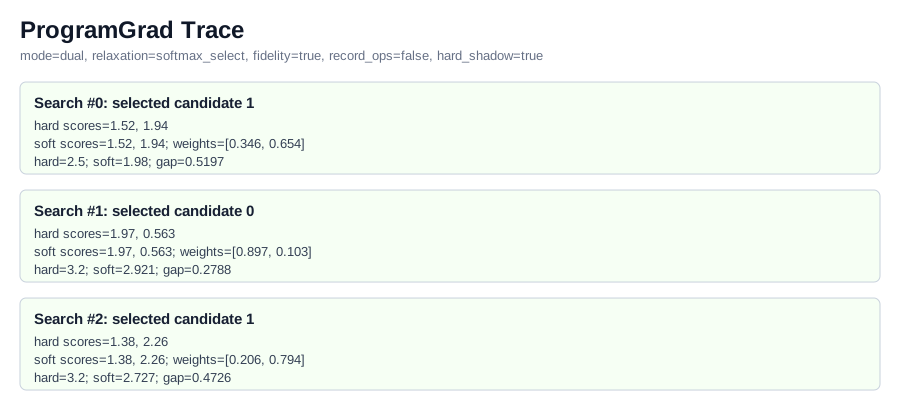
python -m unittest discover -s tests -vpython examples/learnable_threshold.py
python examples/tiny_tree_search.pyEach demo prints the trace ledger and writes an SVG trace in the current directory. They also print hard-vs-soft evaluation tables and temperature sensitivity reports. The CI workflow runs both demos after installing the package.
ProgramGrad focuses on interpretability and semantics, not speed or broad operator coverage. Existing AD systems are excellent for tensor programs and compiler lowering. ProgramGrad targets a narrower gap: making the gradient of an algorithmic decision understandable.
For deeper details, see semantics, evaluation reports, limitations, and the changelog.
The public thesis is:
ProgramGrad is a research-oriented framework for differentiable program traces. It studies how hard algorithmic decisions can be paired with soft surrogate traces, semantic gradient contracts, and fidelity metrics, especially for reasoning and search algorithms.